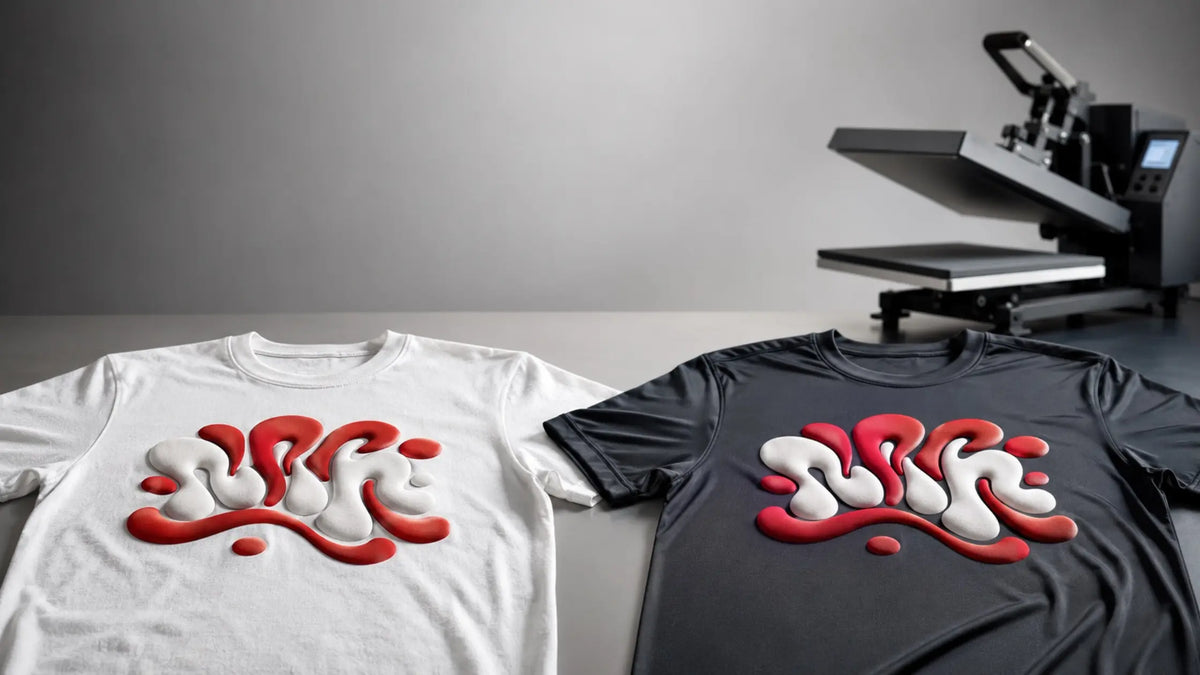
Puff transfers offer dramatic dimensional effects that catch attention on apparel. Fabric type directly impacts puff transfer success, adhesion, and longevity. Understanding how puff transfers perform on different fabrics prevents costly mistakes.
Understanding Puff Transfer Technology
What Are Puff Transfers?
Puff transfers use special adhesive formulas with expanding agents that create three-dimensional effects when heat activated. Puff transfers transform ordinary apparel into statement pieces with visual and tactile appeal. The puffing process requires precise temperature, pressure, and timing control based on fabric type.
How Fabric Composition Affects Puffing
Fabric fiber type directly influences how puff transfers activate and adhere during pressing. Fabric composition determines optimal heat settings and expected puff results. Cotton, polyester, and blended fabrics each respond uniquely to puff transfer application due to their molecular structure differences.
Puff Transfers on Cotton Fabric
Ideal Cotton Characteristics for Puffing
Cotton fabric represents the ideal foundation for puff transfers due to its natural fiber properties. Pure cotton accepts puff adhesive readily and allows proper expansion. Cotton provides excellent puff transfer adhesion with minimal risk of peeling or separation.
Cotton's breathability complements the spongy puff texture, creating comfortable premium garments. Quality puff transfers on 100% cotton typically last 50-100+ wash cycles when properly applied and cared for.
Cotton Sizing and Application Guidelines
Standard cotton shirts require heat press temperatures around 320-330°F for puff transfers. Proper pressure and dwell time ensure complete adhesive activation without fabric damage. Allow cooling time after pressing for complete adhesive setting.
Puff Transfers on Polyester Fabric
How Polyester Responds to Puffing
Polyester presents unique challenges for puff transfers due to its synthetic fiber properties and heat sensitivity. The material melts at lower temperatures than cotton. Polyester requires modified puff transfer settings compared to cotton applications to achieve optimal results.
The synthetic nature of polyester creates different adhesive bonding characteristics. Puff adhesive may not expand as fully on polyester due to fiber rigidity. Lower heat settings become necessary to prevent damage.
Polyester Application Considerations
Lower heat settings (300-315°F) work better for polyester puff transfers compared to cotton. Testing polyester applications on sample garments prevents costly errors. Each polyester blend may require slightly different settings. Pressure settings may need adjustment to avoid permanent impressions or shine marks.

Cotton and Polyester Blends
Understanding Blend Behavior
Cotton-polyester blends represent the most common fabric type in custom apparel. These blends combine natural fiber advantages with polyester durability. Blended fabrics require balancing settings between pure cotton and pure polyester requirements.
The specific fiber ratio impacts ideal puff transfer settings. Higher cotton content blends (70/30) tolerate settings closer to cotton parameters. Higher polyester blends (50/50) require settings closer to pure polyester.
Optimal Settings for Common Blends
50/50 cotton-polyester blends work with moderate heat settings (310-320°F). Different manufacturers may require slightly different settings based on fiber processing. Document tested settings for each blend type used regularly.
According to Textile Care Standards
The American Association of Textile Chemists and Colorists (AATCC - www.aatcc.org) provides comprehensive standards for transfer application on different fabric types. Their testing methods establish guidelines for transfer durability evaluation across cotton and polyester fabrics. Organizations following AATCC standards ensure puff transfer applications meet professional requirements.
The Specialty Graphic Imaging Association (SGIA - www.sgia.org) published detailed guidelines for puff print application. Their research indicates cotton fabrics achieve superior results compared to synthetic fibers. SGIA recommends testing on specific fabrics before production.
The Federal Trade Commission (FTC - www.ftc.gov) requires accurate fiber content labeling on garments, which impacts puff transfer performance. Knowing exact fiber composition helps determine appropriate settings. Care label requirements guide customer handling after application.
Durability Comparison: Cotton vs Polyester Puff Transfers
Longevity on Cotton Garments
Puff transfers on quality cotton garments typically maintain excellent appearance through 50+ wash cycles with proper care. The natural fiber's porosity allows complete adhesive penetration and bonding. Cotton's durability and longevity make it the preferred fabric choice for premium puff transfer applications.
Edge lifting occurs less frequently on cotton compared to other fabrics when puff transfers receive proper application. The stable fiber structure maintains adhesion even after repeated wearing and washing. Customers report high satisfaction with puff transfer longevity on quality cotton apparel.
Longevity on Polyester Garments
Puff transfers on polyester may show slightly reduced durability compared to cotton alternatives due to fiber characteristics. The synthetic material's lower porosity can limit complete adhesive penetration in some cases. Polyester puff transfers typically last 30-50 wash cycles under normal care conditions, depending on transfer quality and application technique.
Edge lifting risk increases slightly on polyester puff transfers compared to cotton. Proper application technique and optimal heat settings minimize this risk significantly. How to wash graphic tees properly extends puff transfer longevity on all fabric types including polyester garments.

Fabric Care Impact on Puff Transfer Performance
Proper Care Extends Puff Transfer Life
Washing techniques dramatically impact puff transfer durability regardless of base fabric type. Turning garments inside out during washing protects puff transfers from direct friction and agitation. Cold water and gentle cycles preserve puff dimensional effects better than hot water and vigorous washing.
Air drying proves superior to machine drying for puff transfer longevity. High heat from dryers can soften adhesive and reduce puff effect intensity over time. Educate customers about proper care to maximize their investment in premium puff transfer apparel.
Customer Communication Matters
Provide detailed care instructions with every puff transfer garment. Clear guidance on washing, drying, and storage practices prevents customer dissatisfaction from premature failure. Clear care instructions protect both customer satisfaction and your reputation for quality work.
Making the Right Fabric Choice
Recommendations by Application
Choose cotton for premium quality applications where maximum durability and appearance matter most. Professional apparel and high-value orders benefit from cotton's superior puff transfer performance. Cotton works best for customers prioritizing longevity and aesthetic appeal.
Polyester works well for casual wear, event merchandise, and applications where budget constraints exist. Blend options provide middle-ground solutions for most general custom apparel needs. Consider customer expectations and intended garment use when recommending fabric types.
Final Words
Puff transfers perform excellently on both cotton and polyester fabrics when using appropriate heat settings and application techniques. Cotton provides superior durability and puff expansion while polyester requires modified settings and careful temperature management.